Fine Science & Art · A closer look
A second is a shared agreement with nature.
Atomic clocks make time reproducible. The interesting part is what happens when precision meets the irregular turning of the Earth.
October 2, 2026 · About 3 min read · Editorial
View figure data
| Observation | Accumulated offset (seconds) |
|---|---|
| Day 1 | 0.0864 |
| Day 2 | 0.1728 |
| Day 3 | 0.2592 |
| Day 4 | 0.3456 |
| Day 5 | 0.432 |
| Day 6 | 0.5184 |
| Day 7 | 0.6048 |
Read, listen & keep
The shared player shows current recording availability and offers an MP3 download when ready.
Your clock is keeping two kinds of promises
A clock can be wonderfully steady and still disagree with the Sun. That is the small conceptual surprise behind timekeeping: a repeatable unit and a rotating planet do not answer exactly the same question. One asks how long an interval lasts. The other asks where we are in a changing astronomical cycle. Treating them as interchangeable hides the work required to keep a shared time system useful.
NIST explains that atomic time is more stable than Earth's rotation, and that leap seconds have been used to keep the two in agreement. Its historical table records the first leap second in June 1972. This is an evergreen explanation of that relationship, not a prediction of the next adjustment or a claim about a newly adopted time standard. [1]
The tick is a measurement
NIST's account of measuring a second describes atomic transitions as the basis for the unit and optical clocks as a direction of development. A better clock is therefore not merely a faster watch. The challenge is to produce a signal whose behavior can be measured, compared and reproduced. Precision becomes useful when someone else can establish what the measurement means. [2]
There is a cultural connection here. A musical performance can have an expressive pulse while a recording device needs a dependable time base. The beat and the timestamp need not feel alike to serve their purposes. One organizes experience; the other lets systems agree about an interval. Neither is a substitute for listening.
A tiny error, allowed to continue
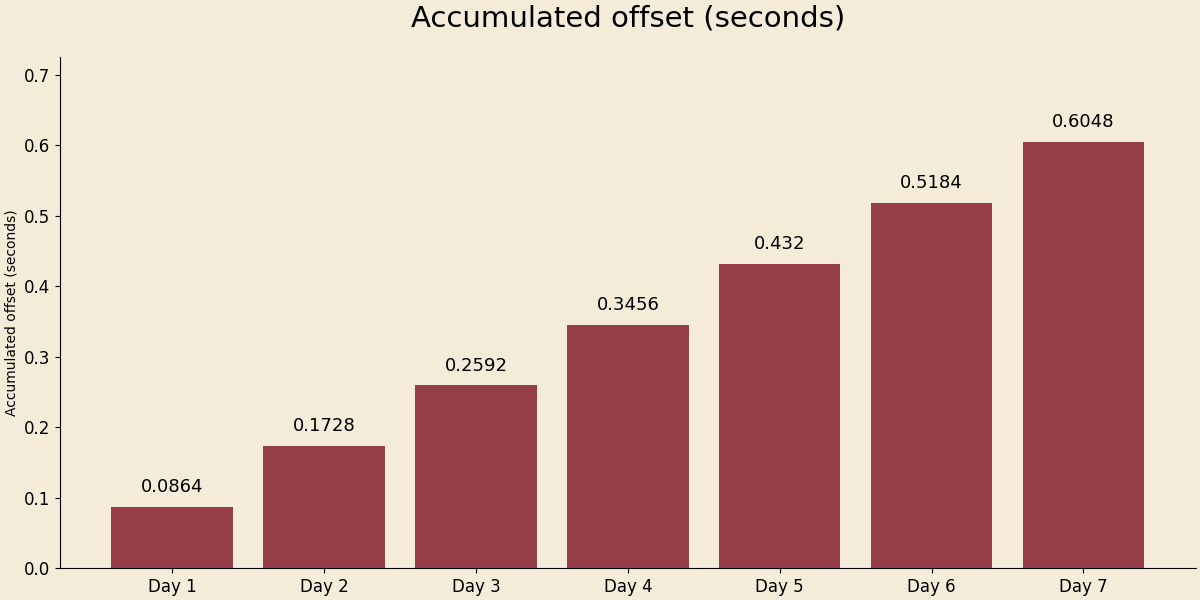
Consider a deliberately exaggerated teaching example: a hypothetical clock gains one microsecond every second. There are 86,400 seconds in a 24-hour day, so it gains 86,400 microseconds, or 0.0864 seconds, per day. After seven days the accumulated offset is 0.6048 seconds. This is arithmetic using an invented constant error, not measured performance of a NIST clock or a forecast of Earth's rotation.
The figure plots that straight-line accumulation. Its lesson is about the difference between rate and accumulated offset. A small rate error can matter if enough time passes; an impressive-looking display with many decimal places tells us little about whether its rate is correct. We would also need a reference, an uncertainty statement and information about how the device changes over time.
Try noticing the agreement
Choose two everyday displays that claim to show the time. Observe whether they change together, without treating the experiment as a calibration. Then ask which activities actually depend on their agreement. Catching a train, joining a call and playing in an ensemble organize time in different ways.
The useful takeaway is modest: whenever a number looks exact, ask what makes it comparable. That question travels well—from a clock face to a laboratory result or a film timeline. Where in your own day does apparent precision conceal a shared convention?
Sources & editorial notes
- NIST · Leap Seconds FAQs
Atomic time and Earth rotation; historical context.
- NIST · How Do You Measure a Second?
Atomic transitions and optical clock development.
Sources checked October 2, 2026. Historical context and an evergreen editorial exercise; not a new research finding. Calculations and interpretations are ours. No independent expert review is claimed.